
 CS
CS UK
UK EN
EN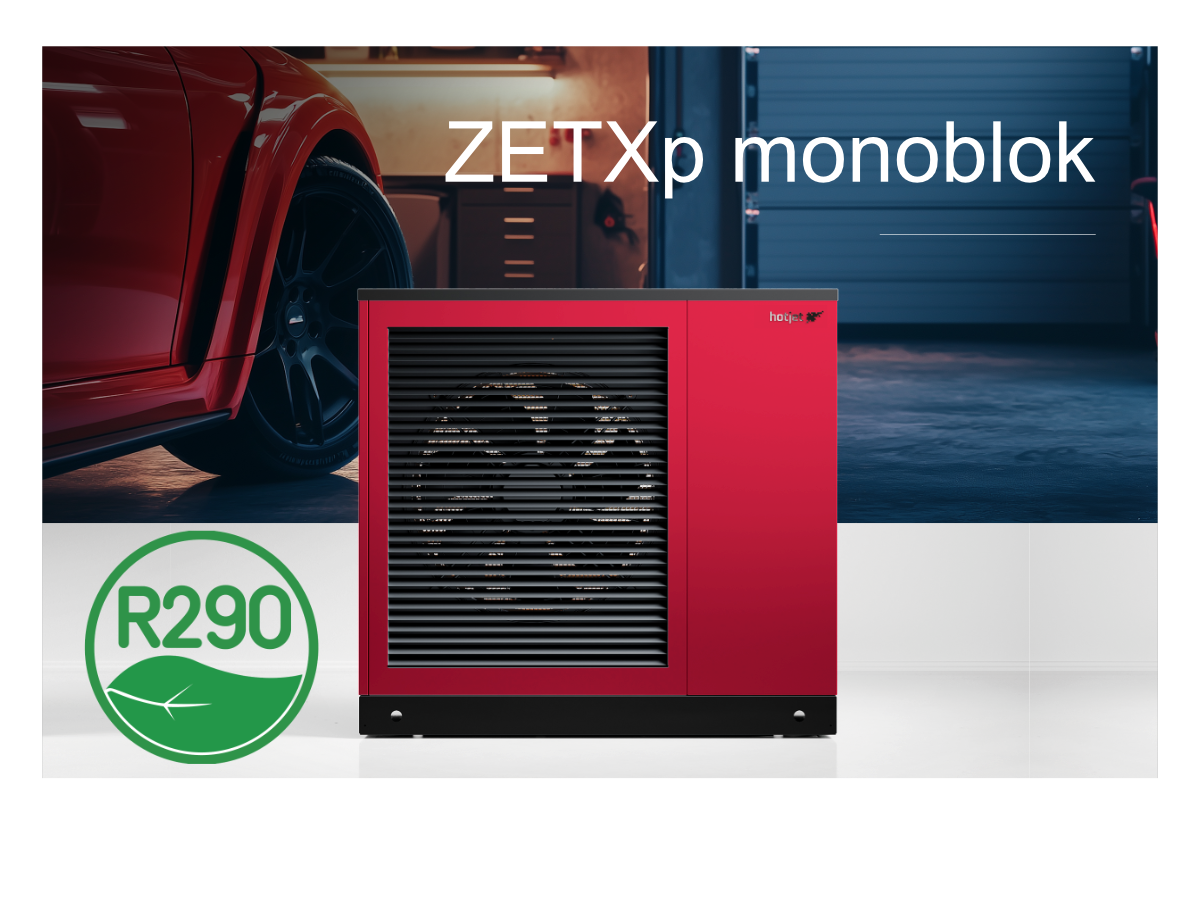
Developing a heat pump is not magic — it is honest engineering work. Let’s take a look at how the HOTJET R&D team built the new ZETXp range with R290 (propane) refrigerant.
The Road to Propane: When the First Attempt Falls Short
We started developing propane-based heat pumps back in 2017, but hit a wall quickly. The inverter technology available at the time simply was not ready for the switch. So we temporarily focused on other refrigerants and returned to propane only a few years ago, armed with better technology.
The reality is that demand for propane heat pumps comes from the majority of our international customers. Interestingly, even among them there are those who admit they will stick with conventional refrigerants as long as they possibly can. In any case, certification of propane units is not the end of the road for us — we are finishing an even more powerful Hotjet 30 ZETXp model, and more are on the way.
It All Starts with Calculations: The Design Phase
Everything begins with hundreds of hours at the computer — analysis, research, thermodynamic simulations. Choosing the right components is critical, especially the heart of the system — the compressor.
“We bet on the best. That is why we continue our partnership with the American company Copeland, a world leader, which goes back to the very beginning of our company,” says Ing. Bremek from the HOTJET R&D team.
Copeland developed a new generation of ultra-quiet scroll compressors specifically for R290 refrigerant, addressing both the safety requirements of propane and the noise problem. Noise is a hot topic right now, and Copeland has made reducing it a priority.
Why Copeland Scroll Compressors?
While cheaper heat pumps often use basic rotary compressors, the Hotjet ZETXp range is fitted exclusively with top-tier Copeland scroll compressors. The difference matters:
Higher efficiency: Thanks to their smooth, uninterrupted compression cycle, scroll compressors achieve higher volumetric efficiency with fewer losses.
Longer lifespan and lower TCO: The design has significantly fewer moving parts (one orbiting scroll versus pistons and vanes), which means less wear and greater reliability.
Minimal vibration and noise: The smooth rotary motion of the scroll generates far less vibration compared to the pulsating operation of rotary compressors.
Trial by Fire: Prototyping and In-House Tuning
The most demanding phase: building the first prototypes and uncovering problems. The main challenge was uneven refrigerant distribution in the evaporator. When refrigerant does not flow evenly, a large portion of the evaporator surface sits idle and efficiency drops dramatically.
“Our suspicions were confirmed by thermal camera footage in the test lab. It clearly showed ‘dead’, inactive spots on the evaporator. After extensive testing, we found a design that achieved perfect, uniform temperature distribution,” the developers explain.
The Moment of Truth: Certification at SZU Brno
Independent testing at the Strojirenska zkusebna (Mechanical Testing Institute) in Brno is unforgiving. They measure SCOP (per CSN EN 14825), noise (per CSN EN 12102), and above all verify safe operation with the flammable R290 refrigerant.
A Breakthrough in Noise: Gentle Hum, No Whine
A high heating factor was expected, but we were pleased that our noise-reduction measures proved effective. The certification results confirmed that the ZETXp produces no tonal noise components — no whining or whistling, which is common in many competitors’ inverter-driven heat pumps. A correction value of 0,0 dB means clean, broadband sound that resembles a gentle background hum.
The Reward for Persistence: The Final Product
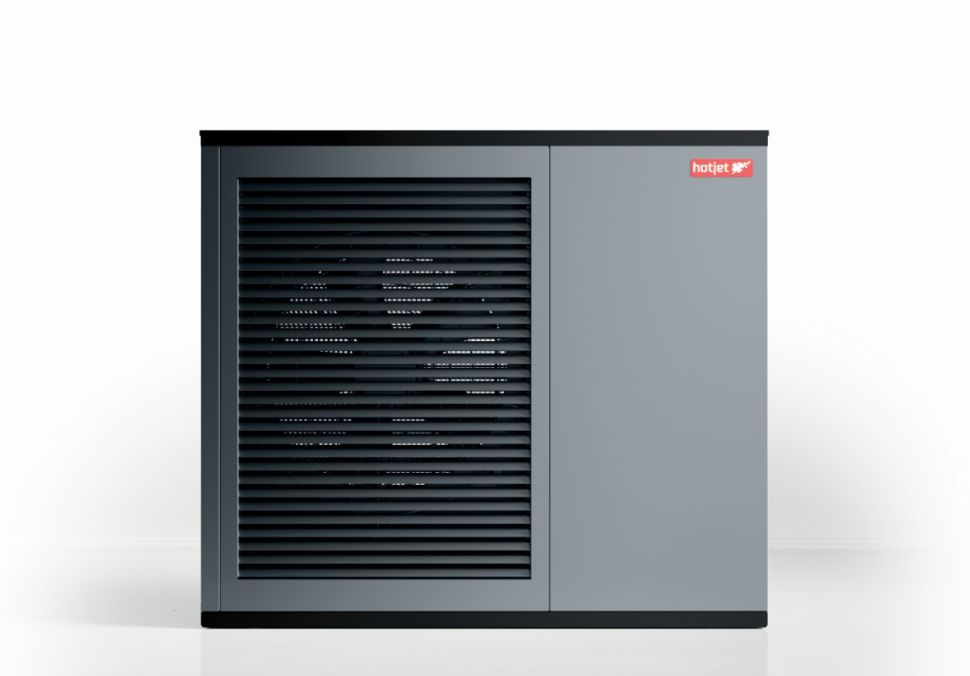
The result is the HOTJET ZETXp heat pump range, boasting top-tier specifications:
- Energy class A+++ for heating at both 35 °C and 55 °C
- Extremely quiet operation: Sound power level (LWA) only 45,3—50 dB(A) under demanding A2/W55 conditions
- High efficiency: COP above 5,6 under standard conditions
- Premium components at a regular price: no premium surcharges
The vast majority of components are manufactured in Europe, and even those labelled “Made in China” come from European manufacturers.
HOTJET ZETXp Technical Data
| Model | Output range A7/W35 | COP A7/W35 | Rated output W35 / W55 | SCOP W35 | SCOP W55 | Energy class | LWA A2/W55 | Sound at 5 m | Dimensions (W×H×D) | Weight |
|---|---|---|---|---|---|---|---|---|---|---|
| 7 ZETXp | 1,7—9 kW | 5,17 | 6 / 5 kW | 4,52 (178 %) | 3,84 (151 %) | A+++ / A+++ | 45,3 dB(A) | 27,3 dB(A) | 1100×1040×600 | 130 kg |
| 10 ZETXp | 2,8—13 kW | 5,44 | 9 / 8 kW | 4,75 (187 %) | 4,00 (157 %) | A+++ / A+++ | 47,0 dB(A) | 29,0 dB(A) | 1100×1040×600 | 140 kg |
| 15 ZETXp | 4,4—22,8 kW | 5,67 | 15 / 13 kW | 4,87 (192 %) | 4,14 (163 %) | A+++ / A+++ | 48,0 dB(A) | 30,0 dB(A) | 1750×1615×800 | 190 kg |
| 20 ZETXp | 5,7—28,6 kW | 5,66 | 19 / 17 kW | 4,84 (191 %) | 4,13 (162 %) | A+++ / A+++ | 50,0 dB(A) | 32,0 dB(A) | 1750×1615×800 | 230 kg |
Why Invest in Quality?
You buy a heat pump for many years. It pays to spend a bit more upfront rather than going with the cheapest option, and then enjoy peace from neighbours, service calls, and headaches.
On top of that, all HOTJET heat pumps are connected to the internet for remote diagnostics and control. Cloud servers are located in Europe — no telemetry data ends up somewhere in Asia.
Market Position and Conclusion
HOTJET ZETXp is the result of Czech engineering, premium components, and thorough testing. It saves energy while respecting the need for a quiet home. The first units are already running at customer sites across Europe.